
A trainer opens your gym at 5:30 a.m. She trains two clients, covers the front desk, and updates a few workout plans. Her third client cancels after she’s already there. Later that week, she teaches a class at your other location and earns a commission on a training package.
Now you have to pay her. The booking app shows two sessions. The time clock shows a desk shift. The sales system shows a package sale. Her class is on another manager’s schedule. You need all four records to check her pay.
That’s where gym payroll gets complicated. One person can earn hourly wages, class pay, session pay, and commissions in the same week. A class can take 45 minutes on the schedule and an hour to deliver. A sale can bring in cash today and create months of coaching work. Here’s how to account for those details before they turn into paycheck problems.
Figure out who should be on payroll
Start with everyone who does work for the gym. That includes trainers, instructors, front desk staff, salespeople, managers, cleaners, and maintenance workers. If you have a pool, childcare room, or online coaching program, include the people who run those too.
Trainers and instructors
Say you sell the training packages, set the prices, assign the clients, and tell the trainer when to work. You also require staff meetings and expect the trainer to follow your procedures. Those facts point toward an employee relationship.
Now picture a trainer who rents space from you. They find their own clients, set their own rates, collect their own payments, and decide how to run their business. Those facts can point toward an independent contractor relationship.
Look at how the arrangement works day to day. A contract, a certification, or a schedule with only two classes a week gives you one piece of the picture. Federal tax rules, federal wage rules, and state laws can use different tests. Check the arrangement again if it changes. For example, a trainer may start out renting space and later begin working with clients your gym assigns. IRS worker classification guide · U.S. Department of Labor worker classification guidance
Managers on salary
A manager can be salaried and still qualify for overtime. If you’re treating a manager as exempt, check the applicable pay and job duties requirements. Look at what they actually do. How much responsibility do they have for running the club? Do they supervise staff? What role do they play in hiring or firing? If a manager spends most of the week checking in members and selling memberships, take a closer look at their actual responsibilities. Keep time records for salaried employees who are eligible for overtime. U.S. Department of Labor guide to overtime exemptions
Paying yourself
How you pay yourself depends on how the gym is taxed. A sole proprietor generally takes owner draws. Partners generally receive distributions or guaranteed payments, depending on the arrangement. An S corporation owner who works in the business generally needs to receive reasonable wages for that work before taking non-wage distributions. If your gym is an LLC, check how it’s classified for federal tax purposes before setting up owner pay. IRS employer tax guide · IRS guide to S corporation owner pay
Write down how each job pays
A coach might earn $18 an hour at the front desk, $40 per training session, and $55 per group class. They might also earn a commission for selling a package. Write down what triggers each payment, how it’s calculated, and when it goes on a check. Give the plan to the employee and the manager who approves their pay.
| Type of pay | What to spell out |
|---|---|
| Hourly pay | Which rates apply to desk work, opening and closing, cleaning, meetings, and admin work. Show staff how to record a change in duties during a shift. |
| Personal training | What you pay for 30- and 60-minute sessions, intro sessions, small groups, and online coaching. Explain how employees record prep time and client follow-up. |
| Group classes | What you pay for regular classes, workshops, and substitute coverage. Say who approves a substitute and who updates the schedule to show who taught. |
| Commissions | Which sales count, who gets credit, what amount the commission is based on, and when it’s earned and paid. Cover discounts, payment plans, renewals, and refunds. |
| Bonuses and shift premiums | What earns a bonus or extra pay, which dates it covers, and when it’s paid. Examples include a bonus for reaching a sales goal or extra pay for opening the gym. |
A package sale and a training session are two different payroll events
Say a salesperson sells a $600 package for ten sessions. Your plan might pay a commission when the customer’s payment clears. The coach might earn session pay each time they train the client. If a second coach takes over halfway through, each coach gets credit for the sessions they delivered.
Now say the member pays in three installments. Does the salesperson earn commission on the full sale or on each payment as it comes in? What happens if the member freezes the package or receives a partial refund? If two employees helped close the sale, how is credit split? Answer those questions in the pay plan while everyone can review the same terms.
Be careful about taking back money already paid. A refund may affect a commission that’s still pending. A commission the employee already earned can raise different wage issues. Check the applicable rules before reversing it or deducting money from a future check. Have a process for commissions that are still pending when an employee leaves. California Labor Commissioner guidance on wage deductions
Pay attention to the work around each session
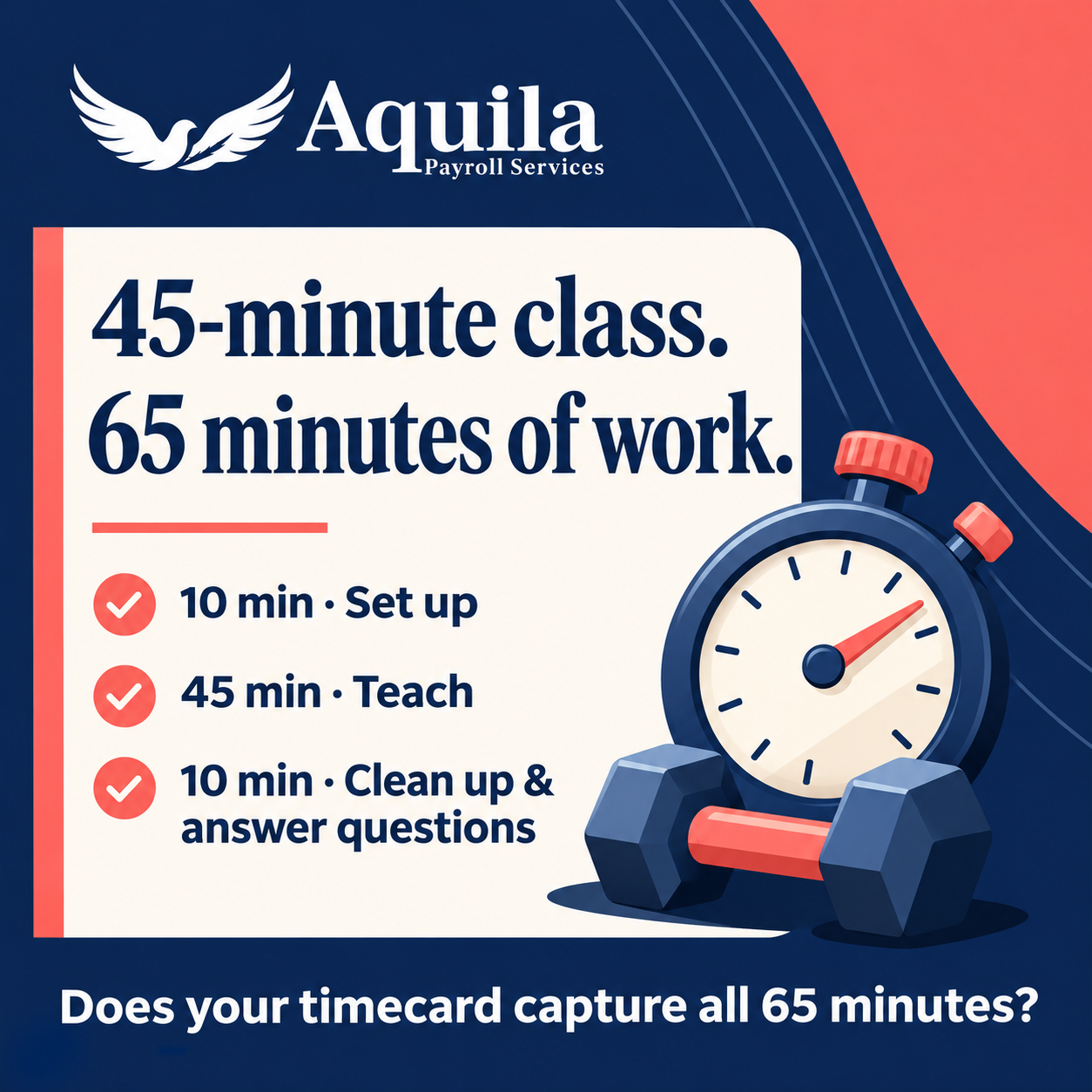
A 45-minute class can take an hour to deliver. The instructor unlocks the room, sets up equipment, teaches, wipes everything down, and answers a member’s question. The booking app shows the 45 minutes members spent in class. The timecard should capture the full time the instructor worked.
Walk through an opening shift, a closing shift, and a busy class changeover. Look for tasks that staff do before clocking in, after clocking out, or between appointments.
- Opening and closing. Unlocking doors, setting alarms, counting the till, and checking locker rooms are easy to miss when the posted shift starts or ends at the same time as member access.
- Prep and follow-up. Setting up weights, writing workout plans, logging client progress, and sending required follow-up messages all take time. Give employees a way to record work they do from home as well.
- Meetings and training. Include required staff meetings, onboarding, and safety drills. Federal rules allow some training time to be excluded when specific conditions are met.
- Travel during the workday. If you send a coach from one club to another after their shift has started, record the travel time. Ordinary travel from home to work generally follows different rules.
- Interrupted breaks. If the front desk employee eats lunch while checking in members and answering calls, review the timecard. An unpaid meal break generally requires the employee to be relieved of duty. U.S. Department of Labor guide to hours worked
Make it easy to fix a missed punch. An employee should know who to tell, what information to provide, and how to check that the time was added. Keep a record of manager edits. If someone worked time you knew about or had reason to know about, review and pay the compensable time even if the employee skipped the approval step. You can address the scheduling issue separately. U.S. Department of Labor guide to hours worked
What happens when a client cancels?
Start with what you asked the trainer to do. If the trainer has to stay at the gym and be ready for a walk-in, that waiting time can count as work. If they’re fully relieved and free to use the time, the answer can change.
Then check for any reporting-time pay required where the employee works. California, for example, has rules that can require extra pay when an employee reports for a shift and receives less work than scheduled. Finally, check your own pay plan for any cancellation payment you promised. The fee you charge the member is a separate question from what you owe the employee. U.S. Department of Labor guidance on waiting time · California reporting-time pay rules
What about the morning and evening rush?
A coach might teach at 6 a.m. and again at 5 p.m. Find out what happens in between. Can the coach leave and use the time freely? Are they expected to stay and cover the floor? Some places also have split-shift rules that can require extra pay when the employer schedules a long unpaid gap. Check who set the schedule and which rules apply at that location. U.S. Department of Labor guidance on hours worked · California split-shift rules
Calculate overtime across the whole workweek
Under federal law, covered employees who are eligible for overtime generally earn it after 40 hours worked in a fixed workweek. If you pay every two weeks and someone works 45 hours the first week and 35 the second, the first week generally has five overtime hours. Run the calculation for each week.
Add the hours an employee works for the same employer across roles and clubs. If a coach works 24 hours at one location and 20 at another, your payroll system needs to see 44 hours. Give one person responsibility for checking the combined total. If separate companies share employees, check whether joint employment rules require you to combine the hours. Also check state rules. California, for example, can require daily overtime or double time. U.S. Department of Labor overtime guidance · California overtime rules
An overtime example with two rates and a bonus
A coach works 30 front desk hours at $18 and 15 coaching hours at $30. They also earn a $90 sales bonus for that week. In this example, federal overtime rules apply, and the coach already earned straight-time pay for all 45 hours.
| Calculation | Amount |
|---|---|
| Front desk pay, 30 hours × $18 | $540 |
| Coaching pay, 15 hours × $30 | $450 |
| Sales bonus | $90 |
| Total before the overtime premium | $1,080 |
| Regular rate, $1,080 ÷ 45 hours | $24 per hour |
| Extra overtime pay, 5 hours × $24 × 0.5 | $60 |
| Gross pay for the week | $1,140 |
The regular rate in this example is $24. It reflects both hourly rates and the bonus. Since the coach already earned straight-time pay for all 45 hours, you add the extra half-time premium for the five overtime hours.
Promised sales, attendance, and retention bonuses generally count toward the regular rate. Some truly discretionary bonuses can be excluded. Timing matters too. If you calculate a monthly bonus after several paychecks have gone out, you may need to go back to the weeks it covers and pay any extra overtime due. Keep enough detail in the bonus records to make that calculation. U.S. Department of Labor regular-rate guide · U.S. Department of Labor bonus guide
Can a commission change who gets overtime?
Some businesses qualify for a federal overtime exemption for certain commissioned employees under Section 7(i). Three things have to line up. The business must qualify as a retail or service establishment. The employee’s regular rate must exceed one and a half times the applicable federal minimum wage in overtime weeks. More than half their pay over a qualifying period must come from commissions.
Check whether your gym and the employee’s pay plan meet all the conditions. A flat fee for teaching a class needs to be evaluated based on how the pay works. Check state law too, since a federal exemption may leave state overtime requirements in place. U.S. Department of Labor guide to the retail commission exemption
For 2026, employers must report qualified overtime compensation on Form W-2 in Box 12 using code TT. For most eligible employees, this is the federally required overtime premium above the regular rate. Make sure your payroll setup can identify that amount on its own, especially if you also pay overtime under state law or offer extra pay under your own policy. IRS guidance on qualified overtime reporting
Check wage and scheduling rules for each location
If you pay by the class or session, look at all the time the employee spends working. A $50 class fee is only one part of the pay review if the instructor also sets up, cleans up, attends meetings, or stays on site waiting for another assignment. Check that the arrangement meets the applicable minimum wage. Some jurisdictions also have specific rules about paying piece-rate workers for rest breaks and other time outside the work covered by the piece rate. U.S. Department of Labor wage guidance · California piece-rate pay guidance
Keep a short list of the rules for each club. Include minimum wage, meal and rest breaks, overtime, paid sick leave, paydays, pay statements, final pay, and any scheduling or reporting-pay rules that apply. Revisit the list when a coach starts working at a different club or from home in another state. You may need to update withholding, leave accrual, or timekeeping based on where the employee is doing the work. Directory of state labor offices
Handle free memberships, expenses, and tips
Free memberships and discounts
If staff get a free membership, family access, or discounted personal training, check how the perk is taxed. The federal exclusion for certain employer-operated athletic facilities has specific conditions. It excludes facilities that are available to the public through paid memberships or similar arrangements. A commercial gym can check whether a separate employee discount exclusion applies. If part of the perk is taxable, make sure payroll knows what value to report. IRS guide to fringe benefits
Uniforms, certifications, and travel
Decide who pays for branded shirts, required equipment, CPR renewals, and mileage between clubs. If you require a course, look at both the cost of the course and the employee’s time attending it. Tell staff how to submit receipts or mileage, who approves them, and when reimbursement is paid.
The same care applies when a key goes missing, the till comes up short, or someone damages a tablet. Check the rules before taking money out of a paycheck. Federal law restricts deductions for expenses that primarily benefit the employer when they cut into required minimum wage or overtime. State rules can be stricter. U.S. Department of Labor guidance on uniforms and wage deductions · IRS employer tax guide
Tips and service charges
If customers can tip for massages or spa services, decide how employees report cash tips and how card tips get into payroll. If you use a tip pool, check who can participate and what rules apply to managers. Give voluntary tips and mandatory service charges separate codes in your point-of-sale system. They can be treated differently for wage and payroll purposes. U.S. Department of Labor guide to tips
Get new hires, taxes, benefits, and insurance set up
Before the first shift, give the employee their pay rates, the workweek and payday, and instructions for recording hours. Collect Form W-4 and any state withholding forms. Complete Form I-9 on schedule and handle state new-hire reporting. For a properly classified contractor, collect Form W-9 and track payments for any required year-end reporting. IRS employer tax guide · USCIS Form I-9 guidance · IRS Form 1099-NEC guidance
Get the right payroll tax accounts in place. Decide who handles withholding, tax deposits, unemployment contributions, and returns. Common federal filings include Form 941, or Form 944 if the IRS assigns it, Form 940 where applicable, and Forms W-2. If a payroll provider handles filings, give them the correct account numbers and check that deposits and returns went through. Keep the confirmations with your payroll records. IRS employer tax guide
Tell your workers’ compensation insurer what people actually do. Someone listed as front desk staff may spend half their week coaching, cleaning, or watching the pool. Ask your insurer how it handles mixed duties and what payroll records it needs for an audit.
Keep an eye on hours for benefits and leave. A part-time instructor who regularly takes desk shifts may reach an eligibility threshold even though the schedule still calls them part-time. As you add employees or clubs, check when federal and state leave rules or employer health coverage requirements apply. If you hire teens for summer camps, the pool, or the desk, check the hours and duties allowed for their age before putting them on the schedule. U.S. Department of Labor FMLA guidance · IRS employer health coverage guidance · U.S. Department of Labor youth lifeguard guidance
Use the same checklist every payday
Pick a pay schedule that meets state rules. Set a deadline for timecards, class changes, and sales records. Give managers time to fix mistakes before you submit payroll. Name a backup approver for vacations and holidays.
- Start with hours. Check missed punches, interrupted breaks, work done from home, and travel between clubs. Combine hours by employee and workweek.
- Match sessions and classes to the people who worked them. Check which appointments were completed, who covered a class, and what happened after a cancellation. Compare booked time with the employee’s actual work time.
- Check commissions and bonuses. Match each payment to the sales record and written pay plan. If someone earns a bonus for an earlier week, check whether that week’s overtime needs an adjustment.
- Read the payroll preview. Look for missing rates, unexpected deductions, unusually low checks, and overtime that may have been missed. If a coach taught their usual schedule but their pay dropped, find out why before submitting.
- Approve and fund payroll. Check that you have cash for net pay, tax withdrawals, and benefit payments. Verify any change to direct deposit through a trusted channel.
- Check what cleared. Match the payroll register to bank activity and your books. Confirm tax payments and filings. Fix rejected deposits and paycheck errors promptly. Keep the records that explain how you arrived at each amount. U.S. Department of Labor recordkeeping guide · IRS employer tax guide
When someone leaves, check the final paycheck deadline right away. It may come before your next regular payday. Review their last hours, earned commissions and bonuses, and any unused leave you’re required to pay out. Give someone responsibility for tracking any commission that can only be calculated later. U.S. Department of Labor final paycheck guidance · Directory of state labor offices
Budget for the work it takes to deliver a class
Say you pay an instructor $40 to teach a class. You also pay for 20 minutes of setup and cleanup at $18 an hour. That’s $46 in direct wages before employer payroll taxes, insurance, benefits, or overtime. With eight people in the room, that’s $5.75 per attendee in direct instructor wages. With four people, it’s $11.50. Look at actual attendance and the full time it takes to deliver the class when deciding whether to keep it on the schedule.
Prepaid packages need the same kind of review. A January sale puts cash in the bank now. You’ll still owe coaching pay as members use those sessions over the following months. Track how many sessions are outstanding, when members are likely to book them, and how many coaching hours you’ll need. Include desk coverage, cleaning, and opening and closing time when you budget for longer hours or another location.
Before your next payday, pull the records for one employee who works more than one role. Take their timecard, bookings, and sales report, and walk through the payroll preview. Can you see who taught the substitute class? Where did the time go when a client canceled? Did both locations’ hours make it onto the same check? Any line you have to guess at tells you which record or pay rule to fix first.